

Miami is no longer just a sunny escape for wealthy founders looking for ocean views and lower taxes. Increasingly, it is becoming a serious corporate base for the tech elite, with billionaire investor Peter Thiel’s record-setting Brickell office lease serving as the clearest sign yet that South Florida’s tech shift has moved from luxury real estate into boardrooms, balance sheets and commercial towers.
Thiel’s reported $250-per-square-foot lease in Miami’s 830 Brickell tower has stunned local market watchers. However, insiders say the deal is not just about one billionaire taking office space. It is about a larger movement of capital, companies and talent away from California and into Florida’s fast-growing business corridor.
Peter Thiel’s Brickell Deal Sends A Loud Signal
For years, wealthy Californians have bought homes in Miami, Palm Beach and nearby enclaves. Now, the story has changed. Tech founders and investors are placing business operations in South Florida, especially as major liquidity events loom for companies such as SpaceX, OpenAI and Anthropic.
In simple terms, the beach-house phase may be giving way to the headquarters phase.
“Peter Thiel in signing that lease, marking a milestone of $250 square foot, absolutely incredible,” DaGrosa Capital Partners founder and chair Joe DaGrosa said. “With the signing of that lease, it’d probably take a year or two for a build out. Once that build-out occurs, not just Peter, but his entire team will be coming to Miami, and that entire team will be buyers of homes or renters of homes. So you can see how that has a virtuous-cycle effect of going from commercial to residential.”
That cycle matters. When executives move offices, employees often follow. Then come housing demand, school decisions, local spending, and deeper roots in the region.
“The entire region is just on fire,” Blanca Commercial Real Estate founder, chair and CEO Tere Blanca said.
“With billionaires like Larry Page and Peter Thiel and Sergey Brin and others that have taken residency here, what we expect is that they will continue to grow their footprints in the region, as has always been the case, when people migrate to Miami.”
Miami Office Prices Hit A New Level
Before the post-pandemic boom, premium Class A office space in Brickell often leased around $40 to $60 per square foot, according to DaGrosa. Thiel’s reported $250-per-square-foot deal pushes Miami into a different league, one that now competes with elite commercial corridors in Manhattan and San Francisco.
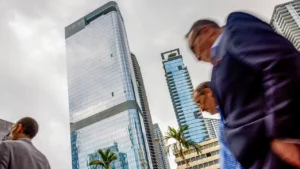
Meanwhile, 830 Brickell has become a symbol of this new era. The 55-story tower is already home to major names including Citadel, Microsoft and Thoma Bravo, with Thiel’s family office expected to join that roster.
“Office space is just like anything else. [It] will be priced based on how much supply and how much demand exists,” Blanca said. “And so with the flight to quality that we’ve experienced in office, even before the pandemic, there is a lot of competition to acquire the best-in-class office space, the best located buildings in areas that feel very familiar to these companies and their executives that are moving here from major cities around the country.”
That competition reflects more than vanity addresses. For companies trying to lure executives, investors and high-end talent, the right building now carries strategic weight.
Taxes, Lifestyle And The California Question
Florida’s appeal is also financial. With California moving toward a ballot fight over a proposed billionaire wealth tax, founders and investors are watching the math closely. Florida offers no state income tax, a business-friendly image and, increasingly, a lifestyle pitch that no longer feels like a compromise.
“It’s both a quantitative and a qualitative discussion, and those two points go hand in hand. From a quantitative point of view, there’s a significant tax savings opportunity at the state-level by moving to Miami,” DaGrosa said.
However, money is only one part of the decision. For many California transplants, the question is whether Florida can match the lifestyle, culture and energy they would leave behind.
“The concern, certainly on the part of a lot of Californians, it’s a wonderful lifestyle out there. Would they be sacrificing lifestyle, the qualitative side of things, for the benefits of the quantitative side? I think they’ve come to realize that they can have the best of both,” he continued, “tax savings and a great quality of life here that rivals, and I would argue surpasses, many parts of California.”
Blanca said high-profile moves from major tech figures and firms send a message far beyond Miami.
“Companies like Palantir that announced headquarters moved to Miami, Peter Thiel being here, is a… statement to other states about the business practices that make Florida so attractive that they’re not seeing in the places where they were residing,” Blanca added.
Can Miami Really Compete For Tech Talent?
Critics still point to one major issue: Silicon Valley has deep engineering talent, elite networks and decades of tech infrastructure. Miami, by contrast, is still building that base.
Still, local data suggests the gap is narrowing. The Miami-Dade Beacon Council has reported tech employment growth of about 25% across the county in recent years, making the region one of America’s stronger metro areas for tech job growth.
There are also company-level examples. Iru, the AI-powered IT and security management firm previously known as Kandji, began in San Francisco and later tripled its physical footprint in Miami after the pandemic.
Blanca said Miami does not need to copy Silicon Valley to win.
“I think that the technology business in Miami should not be compared to, ‘Oh, this is the next Silicon Valley?’” Blanca said. “Miami has its own dynamic and its own opportunity to become a place for founders and entrepreneurs to succeed… And, to protect companies trying to rebuild that in-person culture, Miami is the place to make it happen, right? We have the highest return to office in the country, I think only second to Manhattan. So it really feels like a vibrant and dynamic community for them to attract the right talent and to cultivate the right talents here.”
For employees, however, the shift may become less optional as senior leaders settle in Florida.
“I think the rank and file [employees] have to follow the executives, ultimately. If for no other reason, you need face time with your boss to prove your worth,” DaGrosa said. “So I think you’re going to see a lot of folks following these tech giants. And as evidenced by the increased costs in commercial space, it’s being driven up by the fact that these guys want to bring in their teams.”
Growth Brings Pressure On Housing And Roads
Miami’s rise is not without tension. Rapid corporate growth brings heavier traffic, tighter housing supply and rising costs for residents who were already feeling pressure before the latest wave of wealth arrived.
Still, local leaders and developers say government and private industry are trying to respond faster than they did in the past.
“The city’s doing a good job of expediting permitting,” DaGrosa applauded. “That was a big problem for a long time, but that’s changed quite a bit under former Mayor Francis Suarez and the commissioners from Miami-Dade County… Miami has adapted to the needs of the folks who are coming in here.”
Blanca pointed to workforce housing efforts as another important piece of the puzzle.
“Live Local [Act] that was passed by the legislature about three or four years ago is continuing to evolve to provide that relief that we need in terms of facilitating the development of projects that address workforce housing,” Blanca said. “But more importantly, I think that we have a community that is very aware of the challenges that we can have and is very proactive at coming up with solutions with government support to address these challenges.”
The test, of course, will be whether new housing and infrastructure can arrive quickly enough to match the speed of corporate migration.
“When those projects deliver, we will see that we’ll be in a much better place to check the box as a place where, yes, we have billionaires, and we have great global companies moving here; and yes, you can also bring your employees and your executives here because there is a solution to accommodate all of them at various price points,” she continued.
South Florida’s Tech Boom Spreads Beyond Brickell
As Brickell grows more expensive, corporate interest is spreading north and south across South Florida’s Gold Coast. Large Class A developments across the tri-county corridor are giving companies more options as Miami’s most coveted addresses become harder to secure.
DaGrosa said the capital flowing into Florida can also strengthen public services if managed correctly.
“With that influx in capital, states can do more, the county and the city can do more to help their constituents. So I view it as a big positive. It’s just more money to go around to improve the quality of life for everyone who’s living here.”
Meanwhile, Blanca framed Miami’s growth as part of a broader Sun Belt shift that started before the pandemic and continues to reshape the national business map.
“It’s a natural evolution of what we have seen, even before COVID, where the Sun Belt in general is just experiencing a migration that is phenomenal,” Blanca added. “And there’s opportunity for all cities in the Sun Belt, major cities across the Sun Belt, and for cities around the country to continue to thrive irrespective of what is happening here.”
For now, Florida’s message to Silicon Valley is simple: bring the capital, bring the company, and bring the team. Miami is betting it has enough tax savings, office towers, lifestyle appeal and ambition to turn that bet into a lasting tech capital.