

The hidden nerve links between jaw dysfunctions, motion disorders, tremors, dementia and cognitive decline.
Picture this. A patient sits down in my chair, admits to teeth clenching and grinding, sore jaws, headaches, and is convinced they just need a night guard for a good night’s sleep. I listen, then I connect for them the dots that seemingly no one has yet seen and trace the path of a nerve from their jaw all the way down to their gut. That’s usually the moment their eyes widen. Nobody has ever explained it to them like that before. And that, right there, is the problem I want to talk about today.
Somewhere in Miami-Dade tonight, someone is clenching their jaws in their sleep. In the morning, they’ll blame stress. Their doctor might blame stress too. However, almost no one in that exam room will stop and ask a harder question: is that clenching a symptom of something happening much deeper in the nervous system, or is it a contributor to it? After decades witnessing this, I can tell you the honest answer is usually both.
A Pattern I Couldn’t Unsee
I describe my own scope of practice as everything “from the top of the head to the shoulders.” That sounds like a joke until you realize how much lives in that small piece of real estate. Over the years, I kept running into the same uncomfortable pattern. Patients with jaw pain, clicking joints, and bite problems who also happened to be living with Parkinson’s, multiple sclerosis, fibromyalgia, restless leg syndrome, or Tourette’s. Not one or two patients. Enough that it stopped looking like coincidence and started looking like a map nobody had bothered to draw.
It Starts With a Nerve Most People Have Never Heard Of
The trigeminal nerve (CN V) is the largest cranial nerve (CN) in your skull. It lights up every single time your jaw moves, your teeth touch, or your bite sits even slightly off balance. Here’s what most patients don’t realize, and frankly, what a lot of physicians outside of dentistry ‘may not remember’. That nerve doesn’t work alone. Its pathway intermingles with a cluster of other cranial nerves, including the facial nerve (CN VII), the glossopharyngeal nerve (CN IX), the vagus nerve (CN X), which happens to be the longest and most far-reaching nerve in the entire human body, and the Spinal Accessory nerve (XI).
And it is the interaction of all these cranial nerves that can result in reflex reactions and symptoms seen in many disorders.
I explain it to my patients this way, and it’s the exact language I use in my book. During a storm several small streams of water run down a hillside. Each one may start separately. They merge, and merge again, until you can no longer tell where each individual trickle began and another ended. As I put it, “It’s all ‘one’ stream of water now, isn’t it?” That’s what happens with these nerves: they cross-talk constantly, which means a disruption that starts at the jaw does not necessarily stay at the jaw.
Where This Gets Uncomfortable
Here’s what the clinical literature and further ‘connecting research’ shows about that cross-talk, condition by condition. Take a breath, because this list gets heavy.
Tourette’s Syndrome: Interestingly, Dr. Brendan Stack, an Orthodontist using oral appliance therapy to reduce displaced TMJ discs, discovered that patients who suffered from motion Disorders, following debilitating injuries, as well erratic movements or ‘Tics’, had many of their symptoms successfully alleviated. Here are some interesting examples of motion disorders due to cranial nerve interactions with the trigeminal nerve:
*The facial nerve will produce blinking, facial motor tics of the muscles of facial expression, and Oromandibular dyskinesia (involuntary movements affecting the tongue, lips and jaws). NB: have your dentures checked for the right vertical if they are too worn and older! …
*The glossopharyngeal Nerve: (tongue and throat): throat clearing and sniffing.
* The vagus nerve: can produce Echolalia, a spontaneous uttering of sounds, voice feeling hoarse with throat clearing, grunting and barking sounds.
*The spinal accessory nerve’s stimulation can result in shoulder shrugging and head turning.
All forms of Parkinson’s Disease have as a common denominator the disturbance of the dopamine systems of the basal ganglia, a part of the brain that controls movement. The dopamine deficiency results in the characteristic combination of tremors, slowness, rigidity and postural instability. Cases have also been linked with jaw and bite dysfunction closely enough that movement disorder specialists have studied oral appliance therapy as a supportive tool alongside neurological care.
Multiple Sclerosis has been linked in clinical studies to bruxism, the chronic clenching and grinding that so many patients dismiss as a habit of stress.
Fibromyalgia, a condition that disproportionately affects women between the ages of 20 and 55, overlaps with TMJ disorder symptoms in a way that should alarm more people than it does. Brain fog, morning stiffness, headaches, restless legs, and sensitivity to light and noise show up in both.
Dementia and cognitive decline round out the list. Emerging research has connected chewing function itself to hippocampus-dependent cognitive performance, the very part of the brain responsible for memory.
Now, let me be crystal clear, because this is where a lot of headlines go wrong. None of this means a bad bite causes Parkinson’s. It does not mean fixing your TMJ will cure MS. That is not what the evidence stated here implies.
What it does mean is that the jaw is not some isolated structure that belongs to dentistry alone. It’s wired into the same neurological circuitry driving some of the most devastating diagnoses in medicine, and almost nobody is looking at the whole circuit.
Isn’t it time that we all looked at the human body, from mouth/head to toe, joining diagnostics and information to connect all the pieces?
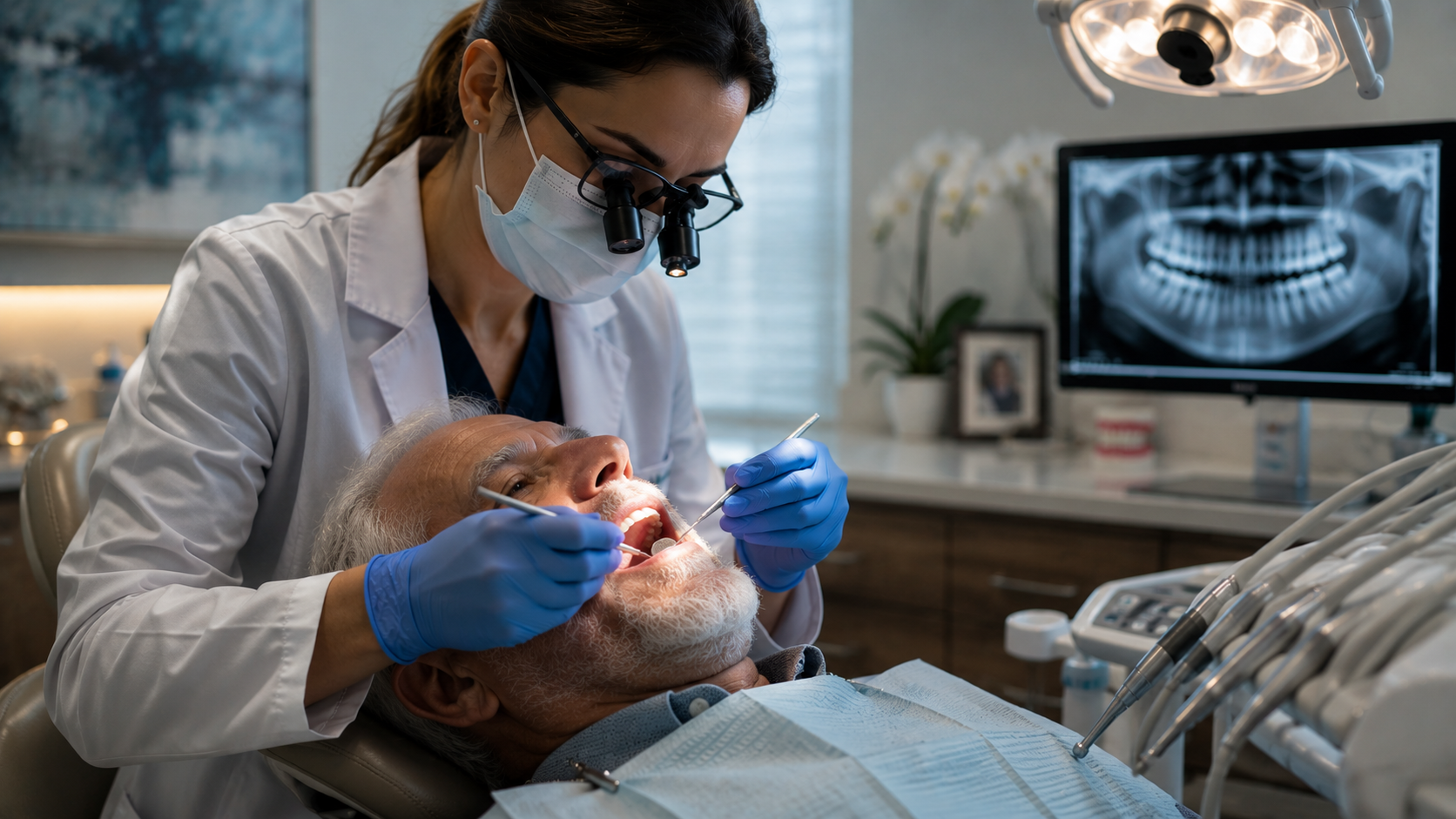
Why Your Dentist Might Catch This Before Anyone Else Does
Here’s something most people never stop to think about. Patients see their dentist more often than they see nearly any other health provider, often twice a year, sometimes for decades, while a slow-building neurological issue quietly gets filed away as “just” jaw pain or “just” a sleep problem. That regularity is an advantage the rest of the healthcare system simply does not have.
A thorough dental exam can catch a displaced disc, an uneven bite, or a pattern of clenching long before a neurologist ever lays eyes on that same patient, mainly because that patient hasn’t been referred to a neurologist yet. To be fair, dentists trained to look for these connections aren’t and cannot diagnose Parkinson’s or MS from the chair. That’s not our lane, and I’ll never pretend it is. But we can be the ones who notice the pattern and say, “This needs a second set of eyes,” instead of adjusting a bite guard and sending someone home none the wiser.
What To Actually Do With This
If you or someone you love is dealing with unexplained tics, tremors, chronic jaw pain, or a diagnosis like fibromyalgia or MS, and nobody has ever looked at how your bite, jaw joint, and posture might fit into that picture, ask. Not instead of your neurologist or rheumatologist. Alongside them.
I talk with my hands, and I get very animated because this stuff genuinely excites me, and I want it to excite you too. This isn’t textbook trivia to me. It’s the reason I chose this profession in the first place, and it’s the reason I still lean forward in my chair every time a new patient sits down and tells me their story.
Your mouth was never meant to be treated in isolation from the rest of the body.
The nerves running through it certainly weren’t built that way either. They reach into your face, your throat, your chest, your gut, carrying signals back and forth every single second of your life, whether you ever stop to think about it or not.
So the next time someone tells you it’s “just” a clicking jaw, or “just” a bit of grinding at night, I want you to remember this conversation. Ask the follow up question. Push for the second opinion. Connect the dots your doctors might not have connected yet. Once you see the connection, you can’t unsee it, and neither can I. That’s exactly why I keep talking about it, chairside, on stage, and now, right here with you.