

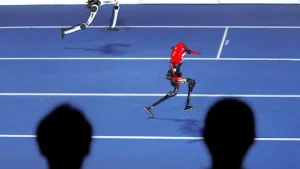
A Chinese humanoid robot has stunned spectators in Beijing after completing a 100-meter sprint in 9.39 seconds, beating Usain Bolt’s legendary 9.58-second world record. The achievement came during the opening of the World Humanoid Robot Games, although the robot’s celebration was considerably less graceful than Bolt’s.
The Beijing-based X-Humanoid robot, named Lightning Bolt, crossed the finish line ahead of the 2009 benchmark before crashing into a blue-cushioned wall. Staff members then placed the machine on a stretcher, highlighting one major difference between today’s robots and the world’s fastest human.
Lightning Bolt Beats A Legendary Record
Usain Bolt set his 100-meter world record at the 2009 World Championships in Berlin, finishing in 9.58 seconds. More than 17 years later, Lightning Bolt reportedly completed the same distance in 9.39 seconds.
However, the robot still had a serious problem after crossing the line: stopping.
Rather than slowing down smoothly, Lightning Bolt slammed into a padded barrier positioned at the end of the track. Staff members subsequently carried the robot away on a stretcher.
Another humanoid robot also posted an impressive time before the games officially opened. A machine developed by Chinese smartphone company Honor reportedly completed a 100-meter sprint in 9.32 seconds during a trial, reaching a peak speed of 14.5 meters per second.
Robots Take Over The Track
The World Humanoid Robot Games are now in their second year and have expanded significantly. Organizers said more than 2,000 robots are taking part across 51 events and approximately 1,000 individual competitions.
The competitions include running, soccer, table tennis, weightlifting and tug of war.
Meanwhile, the event reflects China’s growing ambitions in robotics as Beijing and Washington continue competing for technological leadership.
The games are being held at Beijing’s National Speed Skating Oval, a venue constructed for the 2022 Winter Olympics. The competition opened during the same week as the 2026 World Robot Conference, where companies displayed roughly 3,000 products, including humanoid robots.
Robots Also Challenge The High Jump
The machines are not only making headlines on the running track.
During a standing high-jump competition, one humanoid robot reached 2.88 meters. That result was dramatically higher than the 0.95-meter best performance recorded by a humanoid robot during last year’s inaugural games.
The robot also surpassed the human high-jump world record of 2.45 meters, set by Cuba’s Javier Sotomayor in 1993.
For spectators, the rapid progress has become difficult to ignore.
Humanoid robots are “evolving rapidly,” said Li Yanfeng, an education worker and a Beijing resident.
The development has also prompted mixed feelings among some attendees, particularly as artificial intelligence becomes increasingly capable of performing tasks once reserved for humans.
Spectators Watch The Technology Race
Li said she initially viewed artificial intelligence with concern, particularly because of its potential impact on human employment.
“At first, I wasn’t very accepting of [artificial intelligence]. I was even a bit resistant to it, because of the possibility that it might replace or displace humans,” she said. “But now that I see this development is unstoppable, I decided to come and take a look.”
For another spectator, however, watching robots perform familiar athletic movements was simply impressive.
“These sports are perfectly normal for humans, but now robots can do them. I find it amazing,” said Yang Shangzheng, another spectator.
Liu Tao, who attended the games with his son, said he wanted to see “the best robots China currently has to offer.”
The organizer said 16 countries are participating this year, including Germany, Japan and the United States.
China’s Growing Robotics Industry
The competition comes as China continues to expand its position in the global humanoid robotics industry.
The United States has increased scrutiny of Chinese-made robots, particularly because China produces a large share of the world’s humanoid machines.
That technology race has also reached Washington, where officials have raised concerns about potential national security and supply-chain risks connected to advanced robotics.
The Federal Communications Commission recently banned imports of new foreign-made humanoid robots, saying they “pose unacceptable risks to the national security of the United States or the safety and security of United States persons.”
FCC Chair Brendan Carr also addressed the decision in a statement.
“I welcome these Executive Branch national security determinations, and I am pleased that the FCC has now added foreign produced advanced robotics and power inverters to the FCC’s Covered List,” FCC Chair Brendan Carr wrote in a statement last month. “Following President Trump’s leadership, the FCC will continue to do our part to secure America’s critical supply chains and, with today’s action, the FCC is acting in lock step with our national security agencies to do just that.”
The Beijing competition therefore represents more than an unusual sporting spectacle. It offers a glimpse into how quickly humanoid robots are improving while simultaneously underscoring the geopolitical stakes surrounding advanced robotics.
For now, one thing is clear: Lightning Bolt may have beaten Bolt’s time, but it still has some work to do on the finish.