

A new investigative report has pulled back the curtain on a powerful, secretive network operating at the heart of Iran’s ruling system, revealing an institutional machine designed to preserve control even if Ayatollah Ali Khamenei were to vanish from public view.
The report, titled Unmasking the Bayt: Inside the Supreme Leader’s Office, was written by Saeid Golkar and Kasra Aarabi for United Against Nuclear Iran. It argues that Iran’s true command center is not the government seen by the public, but an expansive shadow structure known as the Bayt, the Office of the Supreme Leader.
The Hidden Nerve Center of the Regime
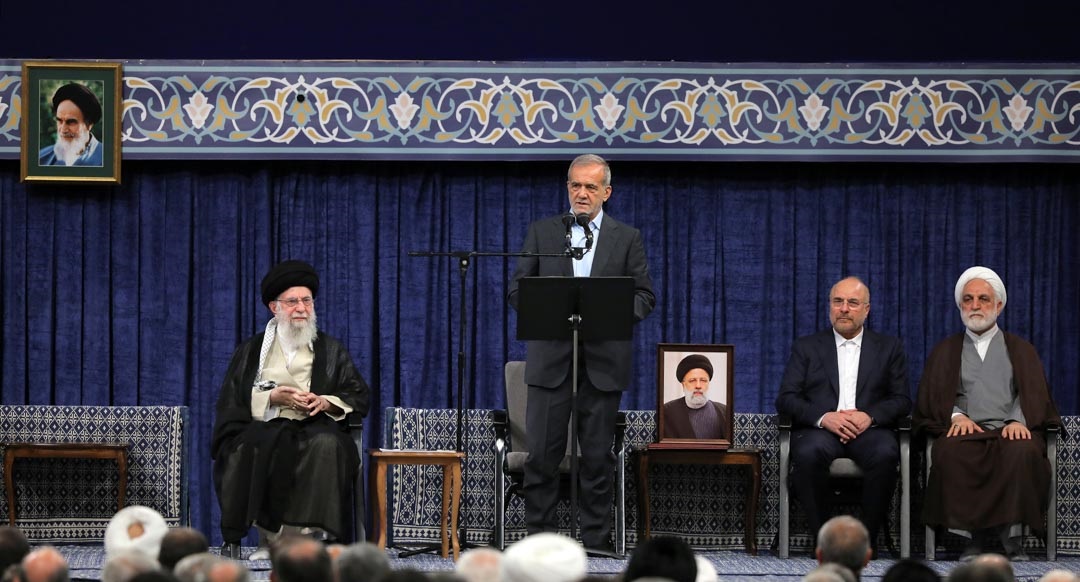
According to the report, this office quietly embeds itself across Iran’s military, economy, clerical institutions, and state bureaucracy. Its influence stretches far deeper than most people realize.
“It is the hidden nerve center of the regime in Iran… it operates as a state within a state,” Aarabi said.
Researchers say this structure lets Khamenei supervise policy at every level, from nuclear strategy to internal security.
“This is what gives Khamenei absolute control. It’s not the visible state, this is the invisible state,” he said.
A 4,000-Person Core With Tens of Thousands Supporting It
The Bayt’s central network is estimated to include around 4,000 direct employees. These individuals are described as ideological “commissars” embedded across the state.
“There’s around 4,000 close employees… think of them as commissars… the real policymakers,” Aarabi said. “Beyond that, the Bayt’s umbrella has 40,000 individuals working for it… entrenched at every single layer of policy, every single state entity.”
At the top of this network sits an elite inner circle, including Khamenei’s sons. The report highlights Mojtaba Khamenei as acting like a “mini-supreme leader” inside his father’s office.
Direct Control Over Military and Nuclear Decision-Making
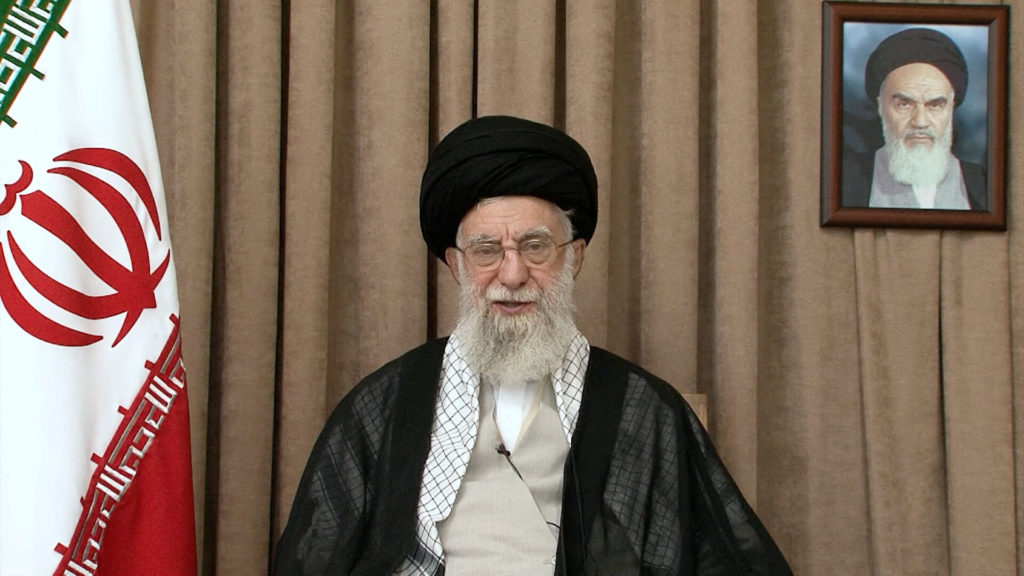
The report explains that senior military promotions require approval from the supreme leader’s office. Parallel counterintelligence bodies enforce ideological loyalty throughout the armed forces.
The Bayt also plays an influential role in nuclear negotiations and wartime planning. In practice, it functions as a duplicate government, mirroring each state ministry with its own internal oversight arm.
The network extends into Iran’s universities, seminaries, media, cultural organizations and economic conglomerates, creating an oversight web difficult to challenge.
“Think of the Bayt as the nucleus of the core power of the regime,” Aarabi said.
Built to Survive Even if the Supreme Leader Disappears
Recent speculation about Khamenei’s health has fueled questions about succession and stability. However, Aarabi argues the system was designed to endure disruptions.
“We saw this during the 12-day war… even if he is hiding in a bunker, he is in full control. The Bayt has been tightening Khamenei’s grip on power,” he said.
The structure is built to function even without Khamenei physically present.
“Even if he is eliminated, the Bayt as an institution enables the supreme leader to function,” Aarabi said. “Think of the supreme leader as an institution rather than just a single individual.”
Above the Government and the Revolutionary Guard
The report places the Bayt at the top of Iran’s power hierarchy, above both the Islamic Revolutionary Guard Corps and the formal state.
“The Bayt is the core apparatus… the strategic policymaking body that is driving the ballistic missile program, the nuclear program, [and] regional destabilization,” Aarabi said.
This, he added, should shape how policymakers in Washington and the region think about pressure or deterrence strategies moving forward.
“Eliminating Khamenei in isolation on its own is not enough… you have to dismantle this extensive apparatus that he has created,” Aarabi said.
A Regime Structure Designed to Be Difficult to Break
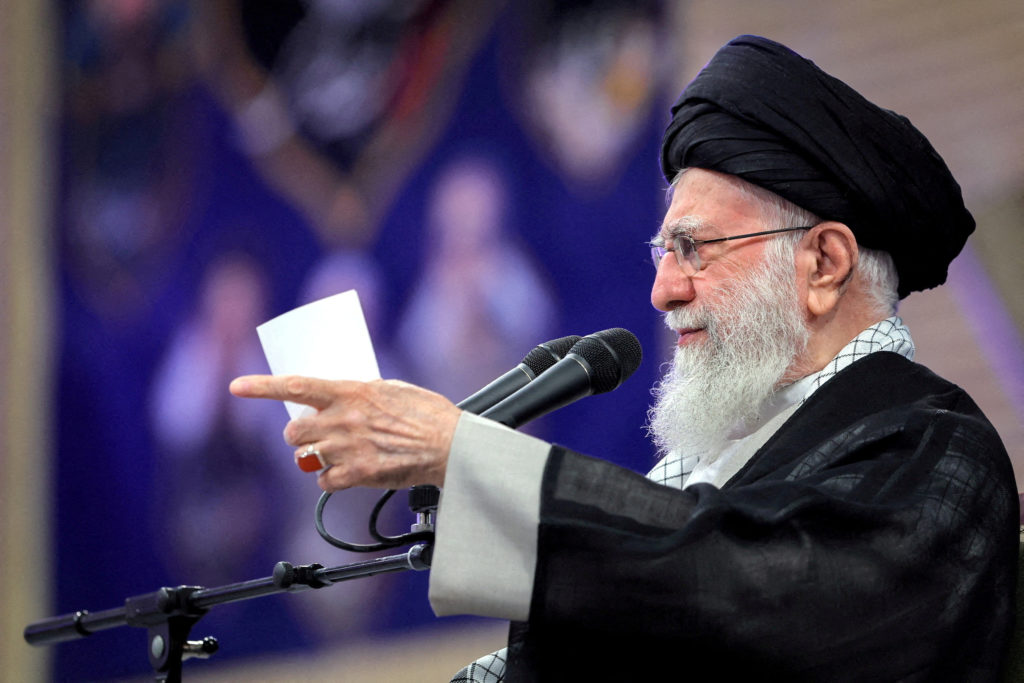
Any effort to weaken the regime, Aarabi argued, would require targeting the entire institutional framework supporting the supreme leader.
“It involves a comprehensive strategy… cyber operations, sanctions, [and] a military component,” he said. “For any meaningful change in Iran… you have to go after the core nucleus of power within the Islamic regime, and that is the Bayt.”
He underscored that simply removing Khamenei would not alter the underlying system.
“The elimination of Khamenei alone is not enough… dismantling the extensive apparatus of the Bayt is essential,” he added.