

Iran’s new supreme leader, Mojtaba Khamenei, is facing growing questions over whether he is actually directing the country’s government after a series of Israeli strikes killed senior Iranian officials.
Israeli national security sources describe Iran’s leadership as severely weakened and internally confused. They say Mojtaba has remained largely out of public view and may have limited control over what remains of the regime.
Israeli Analyst Questions Mojtaba Khamenei’s Authority
Kobi Michael, a defense analyst at the Institute for National Security Studies and the Misgav Institute, described Iran’s new leader as an “empty entity.”
“The new leader is an empty entity,” Michael said.
Mojtaba, the son of former supreme leader Ayatollah Ali Khamenei, took over after his father was killed in a targeted Israeli strike on Feb. 28.
However, Michael said the succession has not translated into clear leadership from Mojtaba.
“Mojtaba Khamenei does not appear in public, but we also have reliable indications that he does not control or lead the regime or what has been left of the regime.
“The current Iranian leadership is broken, confused and is almost misfunctioning.”
The assessment comes as Iran struggles to maintain its leadership structure following repeated strikes against senior military and security officials.
Mojtaba Reportedly Escaped Strike That Killed His Father
Mojtaba reportedly avoided the strike that killed his father by only minutes.
According to leaked audio reportedly obtained by The Telegraph, he had left the compound for a walk shortly before the Israeli missile attack.
The recording, reportedly from a March 12 meeting, allegedly detailed the attack and its impact on members of the Khamenei family.
Mazaher Hosseini, head of protocol for Khamenei’s office, was reportedly heard telling senior officials that Mojtaba sustained “a minor injury to his leg.”
Since becoming supreme leader, Mojtaba has not appeared publicly. Instead, Iranian state television broadcast a message attributed to him that warned of continued attacks and called on Gulf nations to close U.S. military bases.
Meanwhile, reports have circulated claiming that Mojtaba was critically injured or even placed in a coma. Iranian officials, however, have maintained that he is in good health.
Iranian Leadership Suffers More Losses
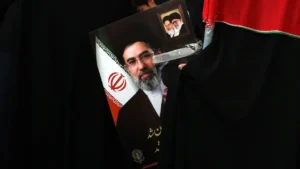
Mojtaba issued a statement Wednesday following the killing of senior Iranian security official Ali Larijani in an Israeli strike.
“Such acts of terror only reflect the enemies’ hostility and will strengthen the resolve of the Islamic nation. Undoubtedly, justice will be served,” the statement said.
Larijani was among Iran’s most senior security officials. Israeli intelligence reportedly located him and other officials near Tehran before the strike.
Other prominent Iranian figures have also been killed during the campaign, including Basij militia commander Gholamreza Soleimani, further weakening the country’s senior security establishment.
Michael characterized the continued targeting of regime officials as part of a broader effort to prevent Iran from rebuilding its leadership and military capabilities.
“This is not a new phase, but a continuing effort and a very successful and impressive one and a crucial component of the strategy meant to weaken the Iranian regime,” Michael said of the continued strikes at regime figures.
He argued that the objective extends beyond individual strikes, with the broader goal of preventing Iran from restoring its previous regional influence.
“This is to the degree that it will not be able to reconstitute itself and/or to become again a severe threat and destabilizing player in the broader Middle East.”
Trump Calls On Iranians To Take Control
The pressure on Iran’s leadership has also been accompanied by calls from the United States for the Iranian people to challenge the regime.
Following the opening U.S.-Israeli strikes, President Donald Trump told Iranians that their “moment of freedom” had arrived.
“When we are finished, take over your government. It will be yours to take,” Trump said, signaling that Washington could support efforts to bring down Iran’s ruling system.
Michael said the strikes were also affecting the regime’s ability to maintain domestic control.
“At the very same time, by weakening the regime and paralyzing its capacities generally speaking and its domestic control specifically, the U.S. and Israel are facilitating the required conditions for the Iranian people to topple the regime,” Michael added.
The question now is whether Mojtaba can establish meaningful authority over Iran’s fractured leadership while the country continues to face military pressure and the loss of senior officials.
For now, Israeli security assessments portray an Iranian government struggling to coordinate its response, with its new supreme leader remaining largely unseen.