

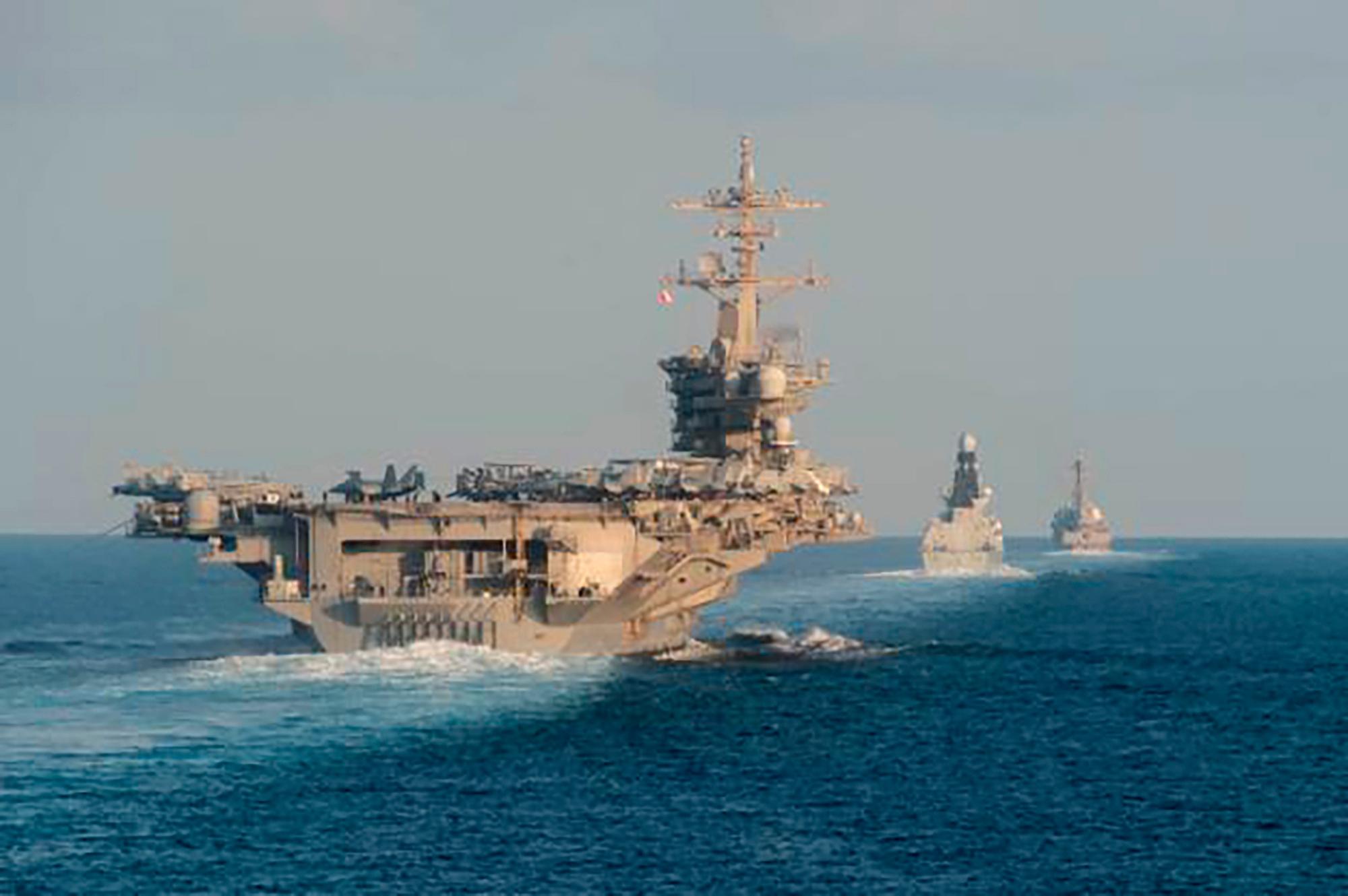
The USS Abraham Lincoln carrier strike group has arrived in CENTCOM waters in the Indian Ocean as the United States responds to heightened tensions with Iran. A senior U.S. official confirmed the deployment and said the move reflects growing concern over Tehran’s recent behavior.
Meanwhile, multiple reports claim Iran’s Supreme Leader, Ayatollah Ali Khamenei, has gone underground. The development has raised alarms among analysts who view the sudden retreat from public view as a possible sign Iran is preparing for military escalation.
Although the Lincoln is now positioned near the region, the senior official noted that the carrier remains unprepared for any immediate offensive actions.
Experts Warn Iran’s Drone Swarms Pose Serious Risks
Cameron Chell, CEO and co-founder of Draganfly, issued a stark warning about Iran’s drone capabilities. He explained that Iran has created “an effective asymmetric threat against highly sophisticated military systems” by pairing “low-cost warheads with inexpensive delivery platforms.”
Chell said Iran can deploy large numbers of low-tech unmanned aircraft in rapid waves, a method specifically designed to strain or overwhelm layered defenses.
“If hundreds are launched in a short period of time, some are almost certain to get through,” Chell said.
He added that legacy defense systems were not built to handle this type of saturating attack.
“Modern defense systems were not originally designed to counter that kind of saturation attack. For U.S. surface vessels operating near Iran, warships are prime targets,” he added.
Khamenei’s Underground Move Raises New Questions
Reports circulating from the region say Supreme Leader Ayatollah Ali Khamenei has gone underground. The shift coincides with rising domestic instability inside Iran and increased regional tensions.
U.S. officials say Washington has begun reinforcing its posture across the Middle East. The response includes movements on air, land and sea while intelligence agencies closely track developments in Syria.
A squadron of F-15 fighter jets has already been deployed. Heavy equipment transported by C-17 aircraft has also arrived, signaling a broader buildup.
Uncertainty Over U.S. Capabilities Against Drone Formations

Chell noted that the U.S. and allied militaries are accelerating efforts to strengthen counter-drone defenses. However, he pointed out ongoing uncertainty about the Lincoln strike group’s newest systems and whether they can effectively counter multiple Iranian drones flying in coordinated formations.
Analysts have increasingly described Iran’s drone fleet as one of the most significant emerging threats in the region.
“These drones give Iran a very credible way to threaten surface vessels,” Chell said. “U.S. assets in the region are large, slow-moving and easily identifiable on radar, which makes them targetable.”
He stressed that Iran’s advantage lies in volume, not sophistication.
“Iran’s strength lies instead in these low-cost, high-volume drone systems particularly one-way strike drones designed to fly into a target and detonate,” he said.