

A dramatic shift may be unfolding in Iran. According to exiled Iranian Crown Prince Reza Pahlavi, the Islamic Republic is beginning to unravel following a series of military strikes that eliminated key leaders, including Supreme Leader Ayatollah Ali Khamenei.
The strikes, carried out by U.S. and Israeli forces last weekend, reportedly killed nearly 50 senior officials tied to the ruling regime. For Pahlavi, the moment represents something bigger than a military operation. He believes it could signal the start of a historic turning point for Iran.
A Moment of Opportunity for Iranians

Pahlavi says many Iranians have been waiting for exactly this kind of moment.
“The situation on the ground is the fact that people obviously were waiting for an opportunity to get back to the streets to take their country back. We see more and more elements of the regime crumbling. A lot of people at home are ready to step in and this is exactly what will be required for a successful and stable transition,” he said.
His remarks come just days after the death of Khamenei, the most powerful figure in Iran’s political system for decades. With the leadership structure shaken, opposition voices believe a path toward political change may be emerging.
Still, Pahlavi argues that any transition must fully detach from the current ruling system.
“Only a clean break will ensure that not only we achieve a democratic solution and alternative to this regime, but there will be people who are not in any form or shape directly associated with this regime,” he said.
Calls for a Democratic Transition
The crown prince, who is the son of Iran’s last monarch, Shah Mohammad Reza Pahlavi, has long advocated for replacing the country’s theocratic government with a democratic system.
He believes the future of Iran must ultimately be decided by its citizens, not foreign powers or political elites.
“The transition involves leaving the people of Iran with that choice, and only the ballot box should determine the outcome and who would be, in the future, responsible for our country,” Shah Mohammad Reza Pahlavi said.
At the same time, Pahlavi emphasized the role Western democracies could play in supporting that process.
“I think what we will expect any government, including, of course, the current Trump Administration to recognize that indeed the best way to help the Iranian people is to allow them to make that choice freely and to support that choice as a Western democracy, as the leading democracy in the world.”
Democracy Seen as the Only Acceptable Outcome

When asked whether other forms of government might emerge, Pahlavi dismissed those possibilities.
He insists that only democracy would be acceptable to the Iranian public.
“I don’t see any formula outside democracy that will be lasting, tenable, or acceptable. The only way that people will accept the outcome is to make sure that they are in charge of their own destiny,” he said.
“And I don’t think there’s any other way than a democratic system that can guarantee that. That’s a recipe for stability, long-term progress, a guarantee of protecting all the citizens of all of their rights.”
For supporters of political reform in Iran, the current instability may open the door to long-sought changes.
Economic Potential After Political Change
Beyond politics, Pahlavi argues that a democratic Iran could reshape the region economically and diplomatically.
He says Iran’s economy has been largely cut off from global markets for decades due to sanctions and political tensions. If a new government emerges, he believes that could change quickly.
“As a democracy, Iranians will be committed to establish an element of cordial relationship with our neighbors, bring peace to the area, bring an element of stability, which ultimately is conducive to development, prosperity, something that would be good for us, but it will also be good, for our partners,” he said.
“I think America has a lot to gain as a result. And don’t forget that after the dust settles and we achieve that future, then Iran is open for economic opportunities.”
According to Pahlavi, the potential economic relationship between the United States and a democratic Iran could exceed $1 trillion in the first decade.
A Longtime Voice of the Opposition
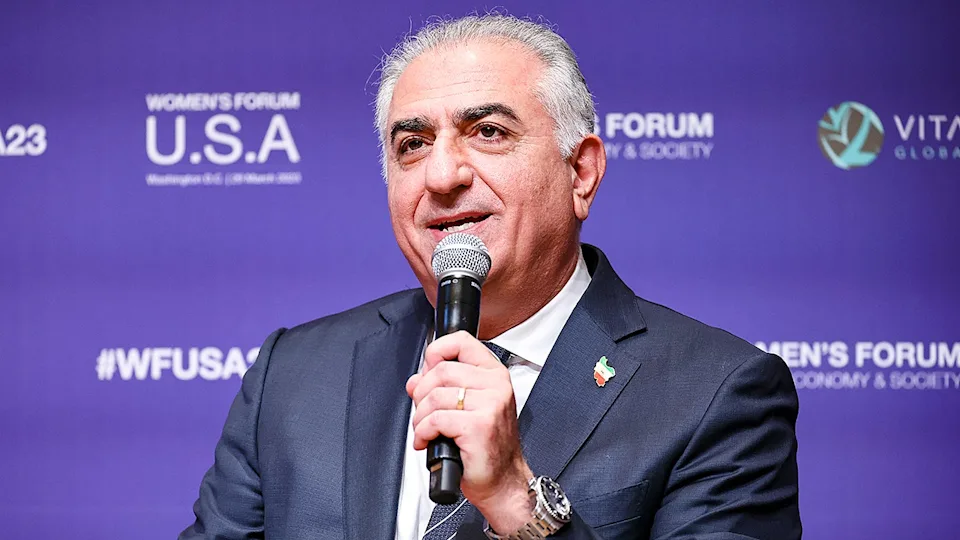
Pahlavi has lived outside Iran since the 1979 Islamic Revolution, which overthrew the monarchy and established the Islamic Republic.
Over the years, he has tried to position himself as a unifying voice among Iran’s fragmented opposition movements. His goal, he says, is not to restore the monarchy but to help guide a democratic transition led by the Iranian people.
Whether that moment is truly approaching remains uncertain. Yet with the country’s leadership shaken and tensions rising across the region, many observers believe Iran could be entering one of the most consequential periods in its modern history.